|
|
|
| Preserve Natural Teeth with Dental Implants |
Wed Dec 7th, 2011 |
|
|
|
Dental implants are intended to replace natural teeth that have been lost or extracted. So, it may seem counterintuitive that the devices can actually protect natural teeth at the same time.
In reality, they can. Dental implants do a much better job of preserving neighboring biological teeth than other tooth replacement alternatives, which are primarily designed to address cosmetic rather than structural concerns.
Dallas patients quickly discover that dental implants have minimal impact on the teeth adjacent to the implant site. A fixed permanent bridge requires healthy enamel of adjoining teeth to be shaved down to accommodate crowns that hold the replacement tooth in place. Dental implants, on the other hand, anchor a prosthetic tooth with no involvement of the remaining teeth.
Furthermore, dental implants offer a layer of protection against the jawbone atrophy that plagues patients when the roots of the natural teeth are absent. In placing dental implants, Dr. John M. Hucklebridge, your implant dentist serving Dallas TX, is essentially replicating the roots of missing teeth.
In this way, dental implants help to stabilize the jaw. When missing teeth’s roots are not replaced and the jawbone is allowed to erode, that process can jeopardize the other teeth, putting the patient at risk for losing more teeth.
The structure of dental implants maintains the tooth’s chewing function, meaning that it absorbs the same forces as a natural tooth would. Those forces continue to be distributed proportionately among all of the teeth, rather than putting extra pressure on a few of them, further safeguarding a patient’s natural teeth.
Because dental implants fit into the smile like natural teeth, they can be maintained in the same fashion. There’s no need to mess with extra equipment to floss, and it’s easier to keep those replacement teeth clean and clear of bacteria that can cause periodontal disease and tooth decay.
If you’ve already lost one tooth and hope to avoid further damage to the others, ask Dr. Hucklebridge about dental implants. They may be the right solution in your case.
|
|
| The benefits of implant-retained dentures |
Mon Nov 21st, 2011 |
|
|
|
Over the last four decades, dental technology has seen tremendous growth. The dental community’s passion for restoring your teeth, health, and self-confidence has given way to new solutions for many common conditions.
Tooth loss and the introduction of dental implants may be the best example of these advancements. In most cases, dental implants have surpassed traditional dentures, bridges, and partials as the recommended method of tooth replacement. Your dentist may recommend dental implants in Plano if you are missing one or more natural teeth and are healthy enough to undergo minimally invasive surgery.
For patients who missing all of the upper or lower teeth, or those patients who are unhappy with their existing denture, adding dental implants can be life-changing.
Your implant dentist may recommend using dental implants to stabilize your denture and preserve your bone structure. By anchoring your denture to the jaw bone, a stable foundation for biting, chewing, and speaking can be achieved. This new foundation is strong enough to endure the forces of chewing without the risk of irritation to the soft tissues of the gums. Patients who choose the implant-retained denture also enjoy the relief of knowing that there is never a need for denture glues and adhesives. The denture will never slip out of place or shift uncomfortably.
Bone loss, the unfortunate side effect of tooth loss, can also be addressed with the addition of dental implants. Since traditional dentures are designed to rest on top of the gum tissue, the underlying bone does not receive the appropriate stimulation and the bone begins to deteriorate. This deterioration affects the fit of the denture as well as the shape of the face and mouth. Dental implants are designed to actually bond, or integrate, with the bone. This relationship provides the stimulation necessary to prevent future bone loss.
Using dental implants to retain dentures has increased the level of comfort and satisfaction for millions of patients with missing teeth. If you are no longer satisfied with the limitations of traditional dentures, schedule your consultation with Dr. John M. Hucklebridge to discuss the beauty of implant-retained dentures today.
|
|
| Dental Implants: What can I expect after treatment? |
Thu Sep 15th, 2011 |
|
|
|
The decision to choose dental implants in Plano to replace missing teeth is certainly the best decision to improve your personal comfort and health. Dental implants are designed to be a long-term or permanent solution for missing teeth. They are strong enough to withstand normal eating and biting. Where esthetics is a concern, implants are beautiful and natural-looking, almost impossible to distinguish from your own teeth.
An important part of your decision to pursue dental implants is a comprehensive evaluation by your implant dentist and a thorough understanding of the procedure from the patient’s perspective. This includes understanding what to expect in the days, months, and years following treatment.
Since the dental implant procedure is typically performed in stages, you should expect at least two healing phases as well. Initially, when the implant is placed, it will be covered and protected by your gum tissue to promote healing. This healing period may last between four and six months, depending on your implant dentist’s recommendation. During this time, you may experience mild tenderness at the implant site, generally relieved by soothing mouth rinses and mild pain relievers, if necessary. For your comfort, you may also be instructed to consume a softer diet immediately following treatment.
When the initial healing phase is complete, your implant will be uncovered and a permanent restoration such as a crown or bridge will be attached. Again, following this second phase, you may experience mild sensitivity as your gum tissue heals. During this period, your diligent brushing and flossing will be essential to a speedy recovery.
When your gum tissue is fully healed and you are comfortable chewing on your new tooth, your main focus should be keeping your teeth clean and free of plaque accumulation. Just like your natural teeth, your implant is susceptible to the bacteria that cause periodontal disease, so proper homecare is your best defense against infection.
A key advantage of the dental implant is its ability to function as a natural tooth. As a result, outside of minimal tenderness during the healing phases, you can expect to care for your implant just as you would a natural tooth. For an informative consultation regarding dental implants in Plano, TX, contact the office of Dr. John M. Hucklebridge at 972-398-2550 to schedule your appointment today.
|
|
| All-on-4: Dental Implants in a Day |
Mon Apr 18th, 2011 |
|
|
|
If you are missing all of your upper or lower teeth and have struggled with the fit and function of traditional dentures, you may want to consider implants as an alternative. Not only can a full arch of artificial replacement teeth now be secured by dental implants, those implants can be placed in a single office visit.
In the past, patients who were missing an entire arch of teeth often had to undergo a bone graft to ensure that they had sufficient bone structure prior to having implants placed. The All-on-4 procedure improves upon past techniques, placing all of the implants near the front of the mouth, where the jaw bone recedes at a much slower rate. This strategy eliminates the need for bone grafts for most patients.
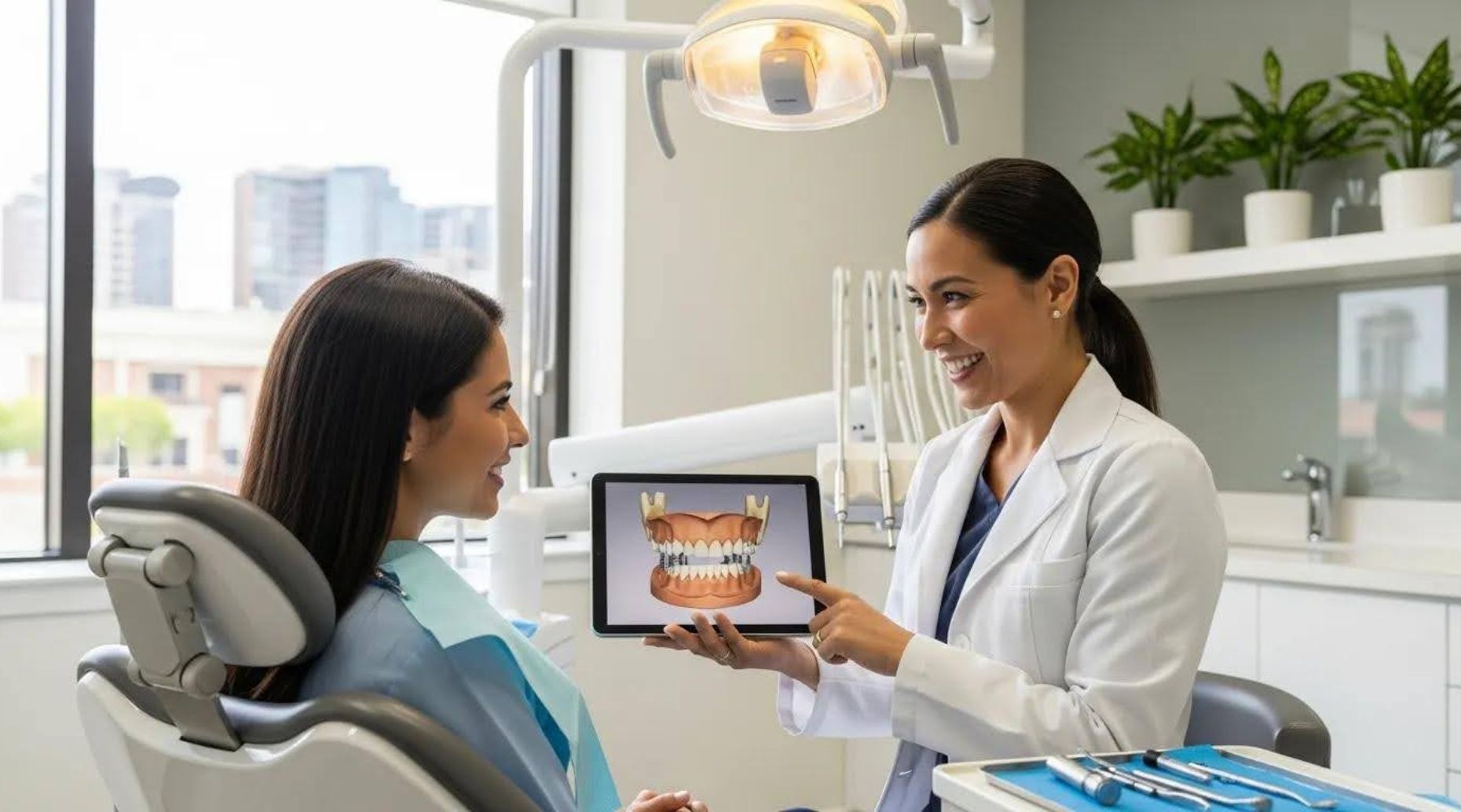
Advances in implant technology allow your implant dentist to identify the precise spot for placement of the small titanium posts, which means that the procedure can be completed more quickly and with a smaller incision. The dentist will use digital images of your mouth and bone structure in combination with three-dimensional planning software to determine the ideal locations for the implants.
Because the All-on-4 procedure is less intrusive and takes less time, patients recover more quickly. In fact, most patients are able to eat a light meal of softer foods later that evening.
All-on-4 dental implants are preferable to traditional dentures for a number of reasons. First and foremost, they’ll prevent further jaw bone resorption because the implant mimics the tooth’s root. The implant serves as sort of an anchor in the bone. Artificial teeth that are held in place by implants also are more secure, and their function replicates that of natural teeth. Patients can speak and eat with ease, without worrying that a slipping or sliding denture will lead to a major embarrassment.
If you are considering dental implants, consult with Dr. John M. Hucklebridge, a Plano implant dentist, to see if you are a candidate for the All-on-4 procedure.
|
|
| Achieve a Beautiful and Confident Smile with Dental Implants |
Fri Feb 18th, 2011 |
|
|
|
Many things can make you self-conscious about your smile, but missing teeth is one of the most serious. Unfortunately, loss of teeth becomes more common as you get older. Teeth can be lost due to injury, gum disease, severe decay or other issues, including wear and tear.
Fortunately, many options are available to replace lost teeth, including bridges, dentures, and dental implants. Depending upon your personal preferences and needs, one of these options can give you a new, full set of teeth. Only dental implants, though, provide a permanent option that replaces not only the biting and chewing surfaces of the teeth, but also the tooth root.
Advantages of Dental Implants
One of the most commonly mentioned issues cited by denture wearers is comfort. Dentures must be carefully fitted, and then must be refitted and adjusted at regular intervals, in order to keep them from moving around in your mouth. When dentures shift in the mouth, they can cause discomfort, or might even move or fall out while you are trying to eat or speak.
Dental implants avoid all these issues because they are permanent and stationary. The visible part of your replacement tooth is affixed to a titanium fixture that takes the place of your natural tooth root. The implant dentist places this fixture directly into the jawbone, where it not only holds your new teeth in place, but also helps maintain the health of the bone in your jaw. Dental implants will not move around in your mouth and do not need to be removed for cleaning.
The Dental Implant Process
Placing dental implants typically occurs in two stages. First, the root portion of the implant is placed in the jawbone. The special properties of titanium allow it to integrate into the bone (grow) through a process called ossification. This can take several months. After the root portion of the Implant has integrated sufficiently, your implant dentist will place the prosthetic teeth, giving you a functional, healthy, permanent smile.
For more information about dental implants in Dallas, please contact our office to schedule a consultation.
|
|
| Standard dental implants v. mini-dental implants |
Mon Dec 27th, 2010 |
|
|
|
Denture wearers annoyed by slippage and discomfort now have a better alternative thanks to the latest advance in implant dentistry offered, mini-dental implants. These devices help to secure a denture arch and keep it in place, helping a denture wearer to chew and speak more naturally.
As their name implies, mini-dental implants, or MDIs, are smaller than standard dental implants. MDIs are typically between two and three millimeters in diameter, while standard dental implants range between around four and six millimeters. MDIs are similar in shape to standard implants, and they are topped by a ball-shaped structure. Because of their smaller size, MDIs are often a solution for patients with bone loss that does not accommodate full-size implants.
During the procedure, the dentist will place a series of four to six MDIs in the jawbone. The denture will have the same number of grooves drilled into its underside, and the grooves are then fitted with metal housings that slide into place over the top of the MDI.
Unlike standard dental implants, MDIs sometimes can be placed without an incision because they are so thin. Using a local anesthetic, they are often placed right through the gums directly into the underlying bone. This process allows them to integrate immediately.
Because the procedure for MDIs is less invasive than the traditional alternative and requires less healing time, the denture can be loaded atop the implants immediately and the patient can even eat later that day. MDIs also tend to cost less than traditional implants, so they are a good option for patients with limited budgets.
Please contact a Dallas dental implants specialist for more information and to schedule a consultation.
|
|
| All-on-Four Dental Implants |
Thu Nov 25th, 2010 |
|
|
|
Although denture wearers often complain of discomfort and poor fit, dentures historically have been the only option for edentulous patients. Now, people who are missing all of their upper or lower teeth have an alternative—All-on-Four dental implants.
The basic All-on-Four process is similar to traditional dental implants, with the dentist anchoring each implant, which looks like a small metal screw, into the jawbone in a relatively simple outpatient procedure. While single implants involve the placement of a lone artificial tooth atop the implant, the All-on-Four variety relies on a complete arch of fabricated teeth that slides over the implants. The underside of the arch features four grooves into which the implants fit.
The main issue that has kept edentulous patients from benefiting from dental implant technology is jawbone resorption. A tooth’s roots help to keep the underlying jawbone from receding, so when the tooth is lost, along with the accompanying root, the bone is more likely to erode over time. Multiple missing teeth compound the problem. Because traditional implant procedures require an adequate bone structure to place the implant, patients with more than a couple of missing teeth were excluded as candidates. Bone grafts offered one solution, but that approach was often an unattractive one for patients due to the extensive surgery and recovery time it entails.
All-on-Four implants overcome this problem by maximizing the remaining amount of bone. The anterior jaw, or the area of bone near the front of the mouth, is typically the last to dissolve. With All-on-Four implants, dentists are able to insert all four implants in close proximity in the anterior jaw. The two outside implants are angled below the gum surface so that the jaw has room to accommodate them, but the part that extends above the gum is straight so that the arch of replacement teeth easily slides into place.
All-on-Four implants can be placed within a short treatment timeframe, allowing patients to leave the dental office with a full set of teeth after a single appointment. If you’ve struggled with dentures, or even resigned yourself to going without teeth, consider the All-on-Four procedure as another possible solution.
To find out more about the All-on-Four procedure, please contact our Dallas dental implant center.
|
|
| The Increasing Popularity of Dental Implants |
Thu Oct 14th, 2010 |
|
|
|
Tooth loss is unfortunately a common side effect of aging. Teeth can also be lost due to trauma, injury or decay. At one time, the only option to replace lost teeth was a bridge or removable dentures. Now, more and more people are choosing dental implants instead.
What are Dental Implants?
Dental implants are a titanium screw that is placed directly in the jawbone to take the place of a missing tooth root. After implants are placed, they must undergo a healing process for several months. During this time, the implant fuses with the jawbone, making the implants permanent and secure.
After the healing time has elapsed, a prosthetic tooth, bridge or full set of dentures can be placed in the mouth. The result is a full set of permanent, high-quality prosthetic teeth that will last for years to come.
Why are Dental Implants Becoming More Popular?
The initial introduction of dental implants as an option for tooth loss represented a huge step forward in dentistry. Since then, implants have become even more effective as dentists have discovered ways to decrease the size of the implant and reduce the likelihood of infection or other complications.
In addition, dental implants provide several advantages over removable dentures. These include:
- Teeth remain fixed in the mouth, without risk of slipping or falling out
- Implants stimulate natural growth in the jawbone
- Implants are stable and do not cause uncomfortable rubbing or friction injuries
- Teeth do not need to be removed to be cleaned
Most people who desire to have teeth replaced are good candidates for dental implants. In some cases, though, existing health conditions or the condition of the gums or jawbone make implants a less ideal option. For example, patients who have experienced a great deal of bone loss in the jaw might need to have bone grafts before implants can be placed.
For more information about dental implants, please contact a Plano dental implants specialist, or schedule a consultation with a cosmetic dentist in the Plano area.
|
|
| Are dental implants right for everyone? |
Sun Sep 5th, 2010 |
|
|
|
Dental implants are titanium fixtures that are placed within the upper or lower jaw to support and replace missing teeth and to anchor loose dentures.
Without natural tooth roots in place to provide stimulation, the jaw bone will begin to deteriorate. Dental implants act as substitute tooth roots and provide the same function as natural roots, including stimulating and preserving the jawbone, thereby preventing the bone loss that normally occurs with the loss of teeth.
Dental implants can be placed in the mouth of any individual provided he/she fulfills certain criteria. Your Plano/Dallas implant dentist will conduct a thorough dental and medical exam to confirm that you are a candidate for dental implant surgery. Dental implants are not placed in children and are only advised after facial growth is complete.
Factors that may rule out implant surgery:
- Insufficient bone height and width
- Unhealthy gums with untreated gum disease
- Patient with history of clenching of teeth (bruxism)
- Patients with previous history of failure of dental implants
- Improper/inadequate opening of the mouth
- Pregnancy
- Severe dermatological diseases
- Malignancy (cancer)
- Smoking
- Diabetes
- Hemophilia and bleeding disorders
- Epilepsy
- Impaired movement
Today with proper medication, patients with diabetes and bleeding disorders can also undergo implant surgery; therefore they are not automatically excluded.
Contact your implant dentist to determine if implants are right for you.
|
|
| Dental Implants: New teeth in a day |
Sat Aug 21st, 2010 |
|
|
|
Tooth loss can be a traumatic experience for people of any age. The quicker the dentist is able to rehabilitate the patient, the faster the patient will be able to return to his/her normal life. Dental implants were a huge step forward for patients wanting a fixed solution to their lost teeth. The duration of treatment (up to 18 months in some cases) needed with conventional implant therapy prevents many people from seeking this form of treatment. In the absence of sufficient bone support bone grafts may be required to support conventional dental implants.
To provide an alternative solution to these problems implant manufacturer Nobel Biocare, along with celebrated implant dentist Paulo Malo devised a technique that uses fewer dental implants without the need for bone graft surgery. Highly esthetic results can be achieved in the shortest time possible with this technique. This method is suited for patients who have lost most or all of their teeth.
The technique called All-on-4 utilizes four dental implants that are angled to achieve maximum support from the bone. Four implants are placed strategically in each jaw to support a fixed bridge. You can receive your full set of new teeth in one appointment; therefore this procedure is also called ‘teeth in a day’.
You can start chewing on your newly received teeth immediately after placement. In certain cases 4-6 implants maybe needed in your upper arch. The dentist will use your first visit to ensure you are a candidate for the All-on-4 procedure and conduct a thorough examination. X-rays and CT scans are needed to complete the evaluation. You receive your new permanent fixed teeth on the day of the procedure, without the need for temporaries. You can visit your Dallas implant dentist in the morning and leave with a set of new teeth the same day.
|
|
|
|
|
|